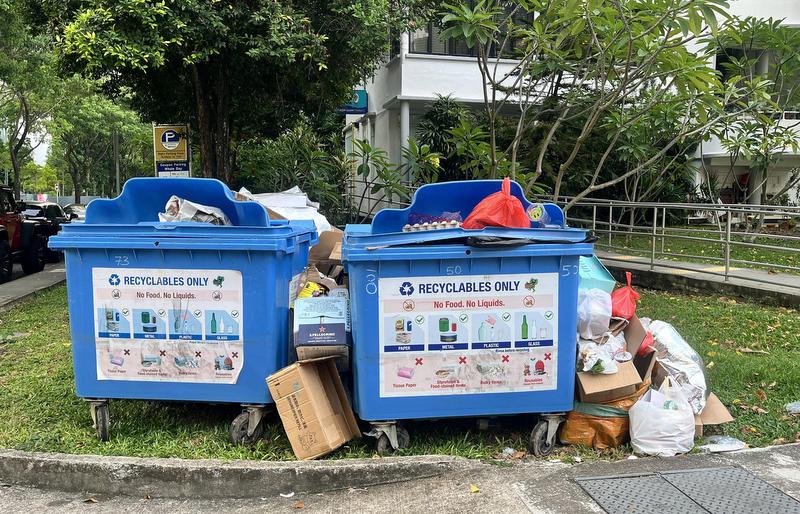
Recycling bins along Moh Guan Terrace in the heritage Tiong Bahru enclave, where you can typically find unflattened cardboard packaging strewn on the ground.st photos: Tan Dawn Wei
Whenever someone in China asks me where I am from and hears “Singapore”, the immediate reaction is almost always one or a combination of these three: “it’s very clean”; “it’s very rich”; or Singaporeans “hen you suzhi (are very refined, well-mannered or civic-minded)”.
Of these three responses, I can comfortably agree with the only one that is grounded in fact – we are, indeed, pretty flush. Up until I returned home in April this year, after nearly seven years in Beijing, I was also inclined to concur that for the most part, our public hygiene standards aren’t too shabby either for a global city.
That was until I moved back to my old walk-up apartment in Tiong Bahru and was shocked to see how the leafy neighbourhood that I love so much had become something of a dump.
The blue bins that the town council had made so accessible throughout the estate to encourage recycling suffer from the most disgraceful abuse imaginable: Disposable lunch boxes tied up in red plastic bags stuffed into the receptacle; soiled coffee cups perched on top of the bins; cardboard boxes with styrofoam and bubble wrap that once swaddled furniture or a home appliance tossed carelessly on the ground, left for someone else to dismantle and dispose of.
No wonder my neighbours tell me the rat infestation problem has gotten worse, and why wouldn’t it, when these open-slot blue bins are basically buffets for rodents with no closing hours?
Among the more absurd sights I encountered in Chay Yan Street: a hulking massage chair abandoned next to a blue bin, its kneading days clearly over. Perhaps the owner figured that by “recycling” it, he could shave off some bad karma; better than consigning it straight to landfill purgatory.
If my friends from China were to come to Singapore for a visit today, I’d be embarrassed to show them around my heritage neighbourhood and tell them this conserved historical enclave was once in the running as a potential Unesco World Heritage Site listing.
If I let them see the used tissue papers and food wrappers that litter the quaint streets and back alleys winding around the famous white pre-war Art Deco buildings, the bubble tea cup so casually chucked into a flower pot, or make them navigate the dog poo minefield, I think they would instantly change their minds about Singapore’s pristine badge of honour, and Singaporeans’ suzhi.
I’d probably skip taking them to our beautiful Gardens by the Bay at dawn, or Marina Barrage on a weekend too, when the grounds are often speckled with the remnants of someone’s McDonald’s Happy Meal.
What has happened to us? Why has our humanity and suzhi regressed even as our standard of living, education and quality of life have progressed?
Does the sad state of our collective hygiene suggest an utter failure of our decades of anti-littering campaigns?
I dived into our archives as I started to write this piece and realised that I wasn’t flagging anything new here: This newspaper has devoted reams to the shameful scourge of littering in this country, including dutifully reporting every iteration of our public cleanliness movement since Mr Lee Kuan Yew launched the first Keep Singapore Clean campaign in 1968.
Sure, we grew. Our population has gone from 5.54 million in 2015 to 6.04 million in 2025. That’s 500,000 more people living on this tiny island. Our tourist numbers have increased from 15.2 million in 2015 to an expected 17 million to 18.5 million this year, according to the Singapore Tourism Board.
More people means more waste, and more ways for public areas to get filthy.
With denser housing estates, more disposable income and the proliferation of online shopping plus the convenience of home deliveries, the infrastructure is groaning under the weight of our obsession with instant gratification, overconsumption and a throwaway culture.
But perhaps it is also campaign fatigue. Singapore has been drowning in cleanliness messages since it became an independent nation. Posters urge residents to recycle properly, schools conduct hygiene lessons, town councils paste warnings near bins. But after half a century, the slogans have faded into background noise.
The penalties – fines for littering range from $300 to $10,000 – are substantial but many residents calculate that the chances of being caught are low, and the deterrent effect has weakened.
The once-feared Corrective Work Order, where offenders were paraded in bright vests and forced to sweep public spaces, has been blunted by lack of visibility. The National Environment Agency expanded the programme to city areas like Chinatown and Tanjong Pagar in 2022. But unless the public shaming is humiliating enough to deter transgressions, this 33-year-old policy also risks becoming just a bureaucratic formality.
Civic deficit
This country has built its global brand on order, discipline and hygiene. “Clean and Green” was not mere marketing; it was proof that modernity could be engineered from nothing. Singaporeans have long internalised the idea that this was part of what made Singapore exceptional, although there has to be an enduring awareness that much of it has been achieved through the thankless, grimy hard work of Singapore’s 60,000 cleaners who pick up after the six million of us.
I fear that we could now be at risk of squandering one of the country’s greatest soft assets. And we will have our entitled attitude to blame.
Singaporeans have grown up with the idea that the Government – and more specifically, the cleaners it employs – will ensure public spaces remain spotless. Outsourcing public hygiene to low-paid labour has created a culture of complacency where cleanliness has become a commodity, purchased through migrant labour; not a civic virtue.
The latest Public Cleanliness Satisfaction Survey, done by the Singapore Management University in 2023, showed 28 per cent of the 2,010 respondents admitted to not disposing of their litter properly. Among these, nearly half said it was because the trash bin was full and there were no other bins nearby.
What is more concerning, is that up to 94 per cent of respondents – an increase of three percentage points from 2022 – expected that cleaners should clear trash throughout the day, so that bins would not overflow.
The truth is uncomfortable. Singapore’s efficient model of governance has left citizens passive and spoilt. We have got too lazy and too used to a lack of accountability – open the rubbish chute in your HDB flats and you can pretty much chuck anything down it. The National Environment Agency doesn’t require you to sort your trash or recyclables either: It hires people to do that for you downstream.
By contrast, trash-sorting is mandated in many other developed countries like Japan and Germany, and if not done properly, collectors will refuse to pick up your rubbish.
It’s not surprising then that Singapore’s domestic recycling rate was a dismal 11 per cent last year, a record low. And as much as 40 per cent of what is recovered in the commingled recycling bins is contaminated.
We don’t deserve our Government’s mollycoddling because we not only don’t appreciate it, we also abuse it. And we won’t become more like the Japanese as long as rubbish bins are easily accessible; we let our trash be the cleaners’ problem, and social disapproval isn’t strong enough to keep us in check.
Japan maintains spotless streets with far fewer cleaners, not because of harsher penalties, but because social norms make littering unthinkable. But I believe we need tough love to force behavioural change because of our civic deficit.
Give the cleaners more days off and reduce the cleaning frequency in housing estates. Make people believe there’s a high chance they will get caught if they litter, and make it painful when they do. Reinvigorate the Corrective Work Order programme to send a stronger signal and instill a sense of consequence.
We’ve managed to make some new habits stick with our tray-return policy through enforcement – 65 per cent return rate before warnings and fines were dished out, to more than 90 per cent now.
When I suggested to the Public Hygiene Council – whose work is about instilling social responsibility – that perhaps Singaporeans aren’t ready for a cultural shift yet, it acknowledged that changing everyday habits takes more than a quick sweep with a broom.
The antidote, it believes, isn’t in simply wielding a big stick but a cocktail of education, community action and peer influence.
I laud their patience and positivity. But the reality is, until Singaporeans own their mess, I’ll have to keep debunking the Chinese myth that we have suzhi.
Tan Dawn Wei
Senior Columnist
dawntan@sph.com.sg